




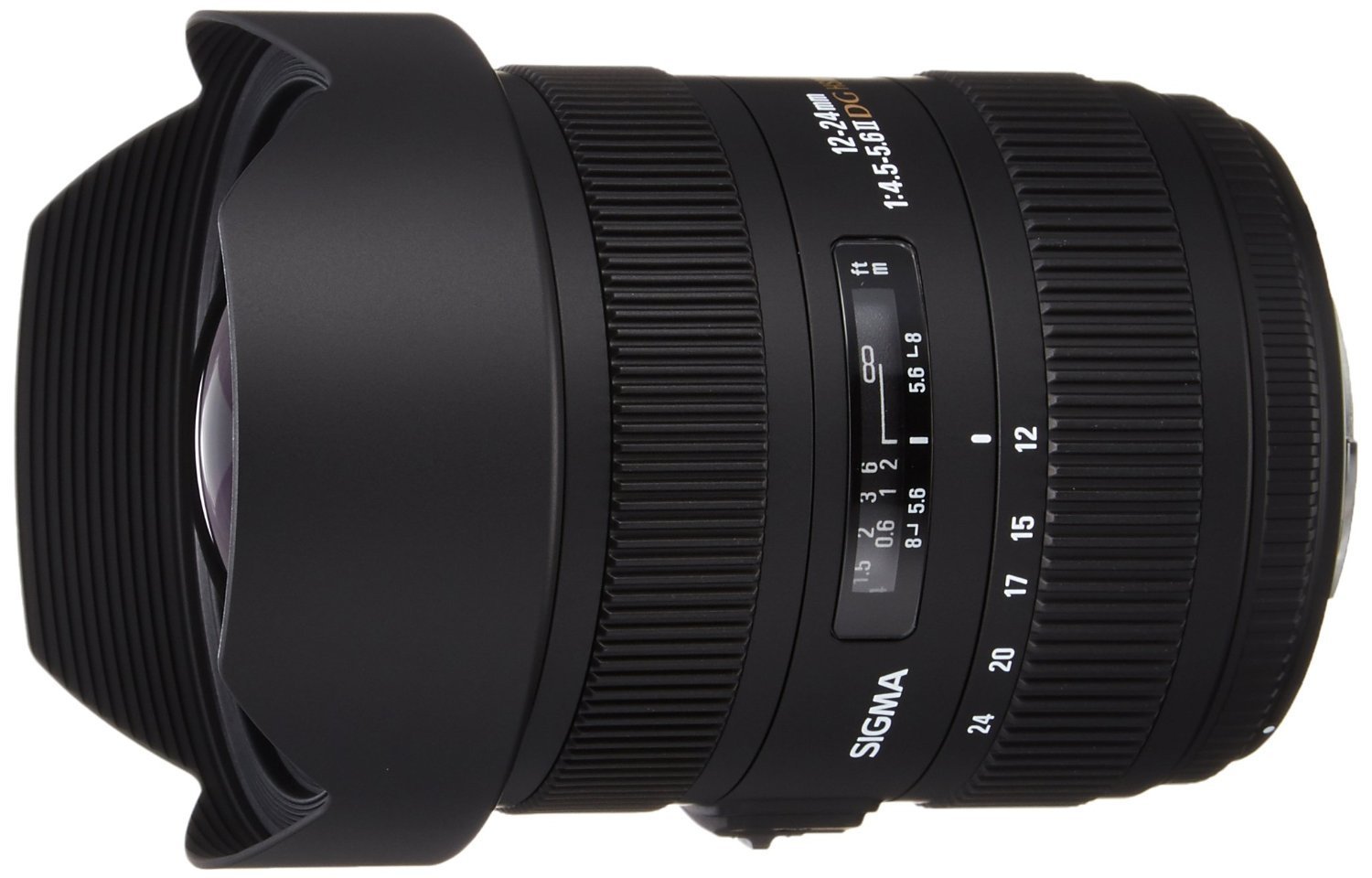

Lente Sigma 12-24 mm f/4.5-5.6 AF II DG HSM para cámaras SLR digitales Sigma
- Marca: Sigma
- Código de Producto: B004M18N3E
-Minimum Focusing Distance - 28cm / 11in.
-Maximum Magnification - 1:6.4
-Maximum Focal Length - 24 mm, Minimum Focal Length - 12 mm
From the Manufacturer Ultra wide angle zoom lens compatible with digital SLR cameras with 35mm full frame image sensor. This ultra wide angle zoom lens incorporates the latest optical design provides superior performance. FLD ("F" Low Dispersion) glass elements, which have performance equal to fluorite, and SLD (Special Low Dispersion) glass elements provide excellent correction of color aberration. Aspherical lenses give advanced performance with a compact and lightweight construction. The Super Multi-Layer Coating reduces flare and ghosting. High image quality is assured throughout the entire zoom range. Incorporation of HSM ensures quiet and high speed autofocus as well as full-time manual focus capability. This lens has superior peripheral brightness and provides sharp and high contrast images even at the maximum apertures. Ultra wide angele zoom: Sigma made it first Sigma designed and produced the first wide-angle zoom lens, the "zoom gamma 21-35mm F3.5-4", in 1979. Sigma has since introduced a number of wide angle zoom lenses. The SIGMA 12-24mm F4.5-5.6 II DG HSM is the successor of the SIGMA 12-24mm F4.5-5.6 EX DG ASPHERICAL / HSM which was launched in November 2003. This ultra wide angle zoom lens is ideal for digital SLRs with a 35mm full frame image sensor and incorporates the latest optical design. Superior image quality The ultra-wide angle zoom lens is possible due to large diameter of the front lens. Four FLD ("F" Low Dispersion) glass elements, which have performance equal to fluorite, and one SLD (Special Low Dispersion) glass element provide excellent correction of color aberration. Three glass mold elements and one hybrid aspherical compensate for all types of aberration and ensure high optical performance. *FLD glass is the highest level low dispersion glass available with extremely high light transmission. This optical glass has a performance equal to fluorite glass which has a low refractive index and low dispersion compared to current optical glass. It also benefits from high anomalous dispersion. These characteristics give excellent correction for residual chromatic aberration (secondary spectrum) which cannot be corrected by ordinary optical glass and ensures high definition and high contrast images. No Super Multi-Layer Coating (left). With Super Multi-Layer Coating (right). Super Multi-Layer Coating Due to the ultra-wide angle, the front of this lens is very large. Sigma's Super Multi-Layer Coating reduces flare and ghosting which could otherwise create problems when extraneous light hits the lens' front element. It also provides sharp and high contrast images throughout the entire zoom range. Superior peripheral brightness The design of front lens group minimizes light fall off and increases peripheral brightness. Exaggerated perspective The wide-angle of view produces striking images with exaggerated perspective, enabling photographers to emphasize the subject. Compact construction Incorporation of four aspherical lenses provides a compact construction with a diameter of 85mm (3.3"), overall length of 4.7" and weight of 23.6oz. The compact construction makes this lens ideal for travel photography. Hyper Sonic Motor Quiet and high speed autofocus HSM indicates lenses equipped with a Hyper Sonic Motor, driven by ultrasonic waves. Incorporation of HSM (Hyper Sonic Motor) ensures quiet and high speed autofocus, while allowing full-time manual focus override. Inner focusing system This lens incorporates an inner focusing system, which eliminates front lens rotation which also minimizes fluctuation of aberration caused by the focusing system Lens Construction In a conventional lens, focusing requires an extension of the entire lens or the front lens group. However, to better accommodate autofocusing mechanisms and closeup photography, a need has arisen for lenses that do not change their length during focusing or suffer from focus-dependent variation in aberration. Therefore, Sigma has developed focusing systems that only move elements within the lens barrel. These incorporate smaller and lighter moving lens elements which help improve auto-focus speed. With their unchanging barrel length and small variation in the center of gravity, these lenses also enhance balance and stability for the photographer. Furthermore, since the front of the lens does not rotate, polarizing filters can be used with extra convenience. Specifications Lens Construction 17 Elements in 13 Groups Angle of View 122 - 84.1 degrees Number of Diaphragm Blades 6 Blades Minimum Aperture (W) F22 Minimum Focusing Distance 28cm / 11in. Maximum Magnification 1:6.4 Dimensions Diameter 87mm x Length 120.2mm / 3.4in. x 4.7in. Weight 670g / 23.6oz. MTF Chart View Larger Image MTF (Modular Transfer Function) is one of the measurements that evaluates a lens' performance, and it contrasts sensitivity at different spacial frequencies. The horizontal axis is in millimeters and shows the distance from the center of the image towar